Andesite Achieves SOC 2 Type II and ISO Certifications, Reinforcing Commitment to Data Security Compliance and Safe AI Practices

The Human-AI SOC company on short list of cybersecurity startups to achieve SOC 2 Type II and ISO 27001, 27701, and 42001 certifications.


MCLEAN, Va., Dec. 10, 2025 /PRNewswire/ — Andesite AI (Andesite) today announced the successful completion of its SOC 2 Type II audit and ISO 27001, 27701, and 42001 certifications. Andesite is one of the world’s earliest adopters of all three ISO certifications. These globally recognized standards and frameworks position Andesite at the forefront of compliance and underscore its commitment to safe, secure, and responsible data and AI practices.

To achieve each of these certifications, Andesite underwent a rigorous independent audit conducted by Schellman, a leader in third-party IT and cybersecurity assessments. Earlier this year, Andesite completed its first FedRAMP High security assessment and is working towards certification, satisfying the standardized approach to cloud security for U.S. federal agencies.

The ISO 42001 certification is the world’s first international standard for AI management systems. It establishes a framework for organizations to responsibly develop, deploy, and monitor AI technologies.

“As an AI SaaS company, we want to ensure our customers see our commitment to security, privacy, and trustworthy AI by design,” said Dave Brown, CISO & CIO at Andesite. “This unprecedented combination of certifications demonstrates the excellence of our Compliance High program and positions Andesite as one of the few companies capable of meeting the highest levels of security, privacy, and AI governance. Our customers can trust that their data and systems are protected at every layer.”

Andesite is secure and compliant by design. From inception, the company has built a security, trust and safety program that permeates all of its practices. Security is at the core of Andesite’s Human-AI SOC product. Their Safe AI Architecture™ protects customer’s data, applications, and network with end-to-end encryption, no extract, transform, and load (ETL) requirements, and the assurance that their AI is not trained with customers’ data.

To learn more about Andesite and schedule a demo, visit andesite.ai.


About Andesite
Andesite’s Human-AI SOC empowers cybersecurity teams with actionable insights that matter to their organization’s risk profile. It enables them to conduct and automate investigations and enrichment, manage high-volume alerts and threat intelligence, assess and determine risk levels. Andesite’s AI technology enables SOC teams to accelerate time to detect, investigate and respond while connecting silos and reducing inefficiencies across data sources, tools and platforms in their security ecosystem. Before Andesite, the company leaders and founders spent decades protecting our nation and some of the largest enterprises on the planet against sophisticated adversaries. Andesite embodies their sense of mission and commitment to develop security products that empower those who work protecting others.

Visit us at andesite.ai, check our trust center at ComplianceHigh.com, and follow us on LinkedIn.


Media Contact:
[email protected] 
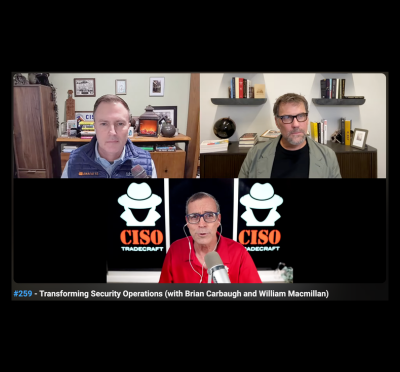
 

Andesite CEO Brian Carbaugh and CPO William Macmillan discussed SecOps on CISO Tradecraft

Our CEO Brian Carbaugh and CPO William Macmillan joined Mark Hardy for a great episode of CISO Tradecraft. They discussed the Human-AI SOC and how AI is transforming security operations.

They delved into the efficiency, accuracy, and proactive threat detection that AI systems bring to the SOC, and the critical role of contextual data in modern threat detection. The conversation covered the challenges of legacy SIEMs, the benefits of AI to solve for alert fatigue, and the sea change offered by a new SOC architecture.

Watch the full interview here.

Andesite’s Chief Product Officer William MacMillan talks with Politico

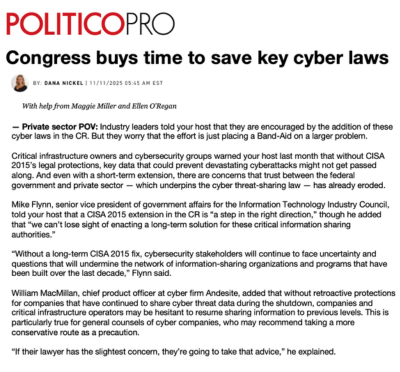
Our Chief Product Officer, William MacMillan, discussed with Politico’s Dana Nickel the importance of the CISA 2015 cybersecurity law and its treatment in the continuing resolution that ended the latest government shutdown. 

MacMillan discussed the importance of retroactive protections for companies and critical infrastructure operators that continued to share cyber threat data during the shutdown. You can learn more about the conversation and the topic on Politico’s cybersecurity newsletter.


Our CPO, William MacMillan, on Empowering Cybersecurity with Change Management

Andesite’s Chief Product Officer, William MacMillan, wrote an article for Security Management magazine about the lessons on change management that he learned as the CIA CISO.

“Organizational change management is inherently anxiety provoking. Focus that change management effort on cybersecurity and you’ve made a stressful, complicated task even more fraught…When you avoid the typical traps, build alignment, and act with conviction and consistency, success is possible. That was the situation I found myself in at the U.S. Central Intelligence Agency (CIA) in the early 2020s. These are the lessons drawn from that daunting but ultimately successful effort. “

“In many organizations, business leaders feel that cybersecurity is a drag on their productivity, and cybersecurity practitioners think that business leaders “don’t get it.” It doesn’t have to be this way. There are principles that can help leaders achieve alignment between cybersecurity and the organizational mission. 

“A fundamental principle that should guide alignment is that cybersecurity risk and operational risk are indivisible. If this principle is violated, alignment is impossible.”

Our CEO, Brian Carbaugh, talked with Channel 8 News NOW at Black Hat

Carbaugh, a former CIA operative who was also part of the first U.S. team deployed to Afghanistan following the 9/11 attacks, was interviewed during Black Hat to talk about his perspective on some of the industry’s biggest challenges: rising AI-driven threats and a shrinking pool of skilled defenders.

Reflecting about his background, he explained, “I spent so much of my time focused on counterterror direct kinetic physical threats to the United States…But you realize playing out in the background all along are those cyber threats, that are persistent, that are coming every minute of the day.”

“The community here in Las Vegas has felt the impact of these attacks across a broad array of targets,” Carbaugh said. “It does highlight the importance of the conference, bringing together people to solve challenges, we’re all feeling it, this pressure.”

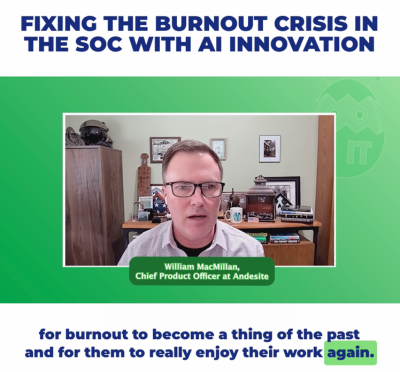
Andesite CPO William MacMillan discusses the SOC burnout crisis at The Pair Program

Our Chief Product Officer, William MacMillan, and Lucas Moody, SVP & CISO at Alteryx, joined the crew at HatchPad’s The Pair Program to discuss a pressing issue: SOC analysts burnout.

The conversation focused on how to reverse the skyrocketing burnout in SOC teams, and how AI can support rather than replace analysts. They emphasized the role of curiosity and creativity in modern cybersecurity and why junior analysts are essential to ensure a sustainable future for cyber defense.

MacMillan shared insights about the shift towards an AI-driven decision-layer built to empower analysts and what is next for Human-AI collaboration in cybersecurity.


Human-AI Collaboration is key to secure government systems, Andesite CPO William MacMillan tells GovCast

GovCast interviewed Andesite Chief Product Officer William MacMillan to talk about the role of Human-AI collaboration in national security.

Artificial intelligence powers many cybersecurity applications, and government agencies are increasingly using AI to augment systems in national security and intelligence capacities. The complexities of AI implementation require careful architectural considerations and robust governance frameworks to ensure safe execution.

William MacMillan, former CISO at CIA and current chief product officer at Andesite AI, noted how AI holds tremendous potential to enhance efficiency and accuracy, particularly through “human in the loop” systems that manage vast amounts of data.

MacMillan also talks about the critical role of leadership in establishing international AI standards and the necessity of user training and human-AI collaboration for effective implementation.


Our Secure by Design Pledge

By Dave Brown, Head of Security and Compliance at Andesite

Building software that is secure by design is at the heart of what we at Andesite are passionate about – it’s the core of our mission and what we pursue as a security vendor. That’s why we proudly signed the CISA Secure by Design Pledge. From foundation to general availability, and since then, we have diligently worked through the Pledge goals to build security and compliance within our product. 

We have developed an internal auditing process with over 450 continuous monitoring controls that constantly validate our work against the Pledge, and we’re proud to openly share that in our Trust Center. That is one of many measures we take to ensure built-in security, compliance, and privacy controls for our customers’ and their customers’ data and networks.

Multi-factor Authentication (MFA)

We are fully committed to implementing multi-factor authentication (MFA). Our Shared Security Responsibilities Matrix outlines that all customers must use their identity provider (IdP) with MFA as part of our commitment to security by default. We integrate with all major identity providers and require that 100% of our customers link their platform instance to their IdP and MFA. We also collaborate with our customers to facilitate the integration of their IdP and MFA during the onboarding process.

Default Passwords

The customer is responsible for addressing default passwords, as we require them to use their identity provider and multi-factor authentication for administrator and user access to our platform. Our primary goal is to help reduce their risk by ensuring that they maintain user access through their chosen identity provider and meet multi-factor authentication requirements.

Reducing Entire Classes of Vulnerability

We have made tremendous progress by implementing tools to address vulnerabilities in our systems at three stages. This includes Software Composition Analysis (SCA), Static Application Security Testing (SAST), and Dynamic Application Security Testing (DAST). These tools enable us to identify vulnerabilities throughout our development, staging, and production phases.

Additionally, twice a year we undergo penetration testing and artificial intelligence assessments to ensure our AI systems’ strong security, compliance, and trustworthiness. We have also partnered with a security company specialized in attack resistance management, continuous assessment, and process enhancement for our Bug Bounty program.

Looking ahead, we are committed to developing a vulnerability notification program for our customers, which will include information on Common Vulnerabilities and Exposures (CVE) and Common Weakness Enumeration (CWE) as part of our comprehensive application security (AppSec) strategy.

Security Patches

As our Shared Security Responsibility Matrix outlines, we are responsible for security patching. We conduct quarterly Approved Scan Vendor (ASV) scans and assessments to prepare for the Payment Card Industry Data Security Standard (PCI DSS). Customers who self-manage our product are responsible for all security patches on those systems.

Evidence of Intrusions

Customer notifications are an essential part of our Incident Response Plan. For confirmed or suspected security incidents, we will collaborate with our customers in good faith to provide the necessary logging to support incident response efforts and meet any regulatory requirements to which the customer must adhere. Customers are fully responsible for evidence of intrusion, logging, or user access, and for providing their IdP with the credentials required for access to their Andesite single-tenant instance.

AI can help the industry finally get SOC automation right

Andesite’s Chief Product Officer William MacMillan writes about how “despite massive investment in tools and technologies, many SOCs still find themselves overwhelmed by the very chaos they aim to control.”

“Analysts are drowning in data, jumping between disconnected tools, and trying to make sense of endless alerts. The result? An epidemic of burnout among the talented security professionals who are critical to keeping organizations safe.

“This has become particularly acute for state and local government security teams that must protect critical infrastructure and sensitive citizen data with typically smaller budgets and staff than their federal or private-sector counterparts.

“Despite this challenge, today we’re seeing states significantly increase cybersecurity investments, with initiatives like the proposed $88 million Cyber Command in Texas and New York’s enhanced cybersecurity funding for its Joint Security Operations Center.

“The root cause lies in a fundamental misconception about security operations. For decades, we’ve tried to impose rigid structure on inherently unstructured problems. Various products promised to bring order through centralization and automation. Instead, they often added layers of complexity, transforming threat hunting from finding a needle in a haystack to finding the right needle in a stack of needles.

Analyst Burnout Is an Advanced Persistent Threat

On Dark Reading, Andesite’s Chief Product Officer William MacMillan writes about how for too long, cybersecurity analysts have been treated as mere cogs in a machine and it’s time to change that and revolutionize security operations.

“In the battle against cyber threats, we’re losing our most vital asset: our people. While the industry fixates on the latest tools and technologies, security analysts are burning out, crushed under the weight of an impossible mission. This isn’t just a talent shortage, but an existential crisis threatening the future of cybersecurity defense. Until we prioritize supporting the humans at the heart of cyber operations, no tool or technology will be enough to keep us secure.

“Security operations centers (SOCs), the heart of cybersecurity, have become pressure cookers of burnout and frustration. The numbers tell a dire story: More than half of SOC analysts have considered leaving the field, and with them goes the institutional knowledge and expertise that take years to develop. Each departure is a victory for malicious actors, who know that even the most sophisticated tools are only as effective as the humans behind them.